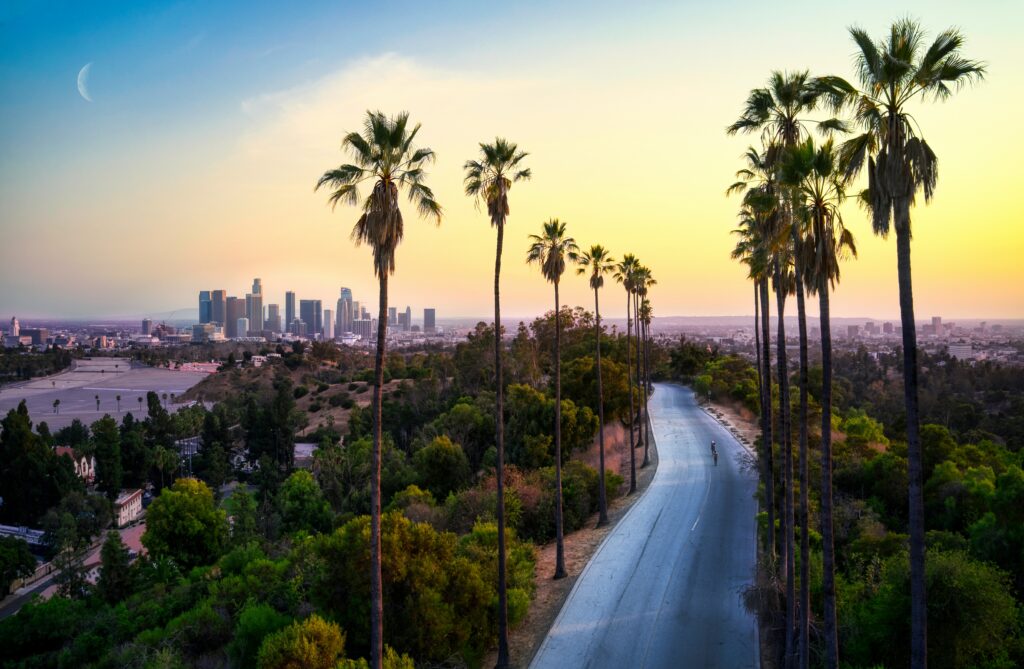
Everyone comes to Los Angeles with the same mental checklist. Hollywood Walk of Fame. The Santa Monica Pier. A drive down Sunset Boulevard with the windows down, hoping to feel like you’re in a movie. And honestly, there’s nothing wrong with any of that. But if you’ve ever spent a sweaty afternoon fighting tourist crowds in front of a star on the sidewalk and thought, is this really it, then you already know the city has been holding out on you.
The real Los Angeles lives in the neighborhoods. In the taco stands that don’t have Yelp pages. In the record shops that smell like dust and old vinyl. In the parks where locals actually go on weekends. That’s the version of LA this guide is about.
So let’s get into it.
Echo Park and Silver Lake: The Creative Soul of the City
If you want to see what LA looks like when it belongs to the people who actually live there, head east of Hollywood toward Echo Park and Silver Lake. These two neighborhoods bleed into each other, and together they’re some of the most genuinely fun parts of the city to just exist in.
Echo Park Lake is one of those places that’s hard to explain until you’re there. On a Saturday you can rent a paddleboat, watch a street performer, eat a bacon-wrapped hot dog from a cart, and hear three different genres of music coming from three different directions, all within the same hour. It’s free, it’s full of life, and it feels nothing like a tourist attraction because it isn’t one.
A few blocks over, Sunset Junction in Silver Lake is where the neighborhood’s personality really shows up. Walk down Sunset Boulevard here, which has a completely different feel from the famous strip, and you’ll find independent coffee shops, bookstores, vintage boutiques, and record stores that have been around longer than most of their customers. Vacation Vinyl and Origami Vinyl are both worth an afternoon. The people-watching alone makes the walk worthwhile.
Don’t miss: Tacos Villa Corona on Larga Ave. Tiny place, cash only, no atmosphere to speak of, and some of the best breakfast tacos in the entire city. Go before 11am if you can.
Silver Lake has also quietly become one of the better neighborhoods for an evening activity that isn’t just another bar. 60out Escape Rooms has a location here that locals have been recommending for a while now. If you’ve never done an escape room in Silver Lake before, this one is worth trying. The rooms are well-designed, the puzzles actually make you think, and it’s the kind of thing a group ends up talking about long after the night is over.
Koreatown: The Neighborhood That Never Sleeps
Most visitors skip Koreatown entirely. This is a mistake, and a pretty costly one if you care about eating well and having a good time.
K-Town sits right in the middle of the city and operates on its own energy. During the day, you’ve got some of the best Korean barbecue you’ll find anywhere. Places like Park’s BBQ and Quarters Korean BBQ put the grill right on your table, and you’ll spend an hour ordering things you can’t name but can’t stop eating. Come with a group. Come hungry.
At night the neighborhood completely transforms. The karaoke scene here is not what you might be picturing. These aren’t dingy bar setups. Spots like Pharaoh Karaoke or VIP Karaoke give you a private room for your whole group, full food and drink service, and a song catalog that could keep you busy for a week. Nights that start at 9pm have a way of ending at 3am, and you won’t regret a single minute of them.
Then there are the jjimjilbangs, the Korean spa bathhouses. Wi Spa on Wilshire is one of the most well-known, open 24 hours, with hot and cold baths, steam rooms, and a co-ed floor with heated clay rooms where people sleep on the floor in matching shorts and it all somehow feels completely normal. Go with an open mind. You’ll leave feeling like a new person.
Pro tip: Parking in K-Town is a genuine nightmare. Take a rideshare, enjoy your soju freely, and thank yourself in the morning.
The Arts District in Downtown LA: Murals, Markets, and Good Coffee
The Arts District started as the place artists moved when they couldn’t afford anywhere else. It’s now one of the coolest pockets in the city, and it still hasn’t completely lost what made it interesting in the first place.
The whole neighborhood functions as an open-air gallery. Every wall seems to have something on it, and some of these murals are genuinely world-class work from internationally recognized street artists. Just walking the blocks between Traction Ave and Santa Fe Ave will take you past dozens of pieces worth stopping for. There’s no map or tour needed. You just walk.
For coffee, Paramount Coffee Project and Alfred Coffee both have locations here and are the kind of spots where sitting for two hours feels perfectly reasonable. For food, Zinc Cafe and Market is a solid local choice for breakfast or lunch, and Bestia, which is tucked into what looks like an old industrial loading dock, is one of the most celebrated Italian restaurants in the entire city. Book well ahead for that one.
On weekends, Smorgasburg LA takes over the Row DTLA complex. It’s a huge outdoor food market with vendors selling everything from lobster rolls to Japanese cheesecake, and it’s probably the most efficient way to eat your way through LA in a single afternoon.
Los Feliz and the Griffith Park Secret
Everybody knows Griffith Observatory. Far fewer people know how much more the park around it actually holds.
Griffith Park covers 4,310 acres and is one of the largest urban parks in the country. Most tourists see the Observatory and call it a day. Locals know the real appeal is in the trails above it. The hikes up toward the Hollywood Sign area, whether you take the trail off Canyon Drive or the Brush Canyon Trail, reward you with views of the whole city that feel earned. There’s a real difference between looking at LA from a parking lot and looking at it from a ridge you just hiked up.
Afterward, come down to Los Feliz Village. Vermont Avenue is lined with indie movie theaters, bookstores, and restaurants that make you want to stay longer than you planned. The Los Feliz 3 is the kind of neighborhood theater that people fight to keep open when it’s threatened. Jeni’s Ice Creams is there. So is Skylight Books, which is one of the best independent bookstores in the city by any measure.
Worth knowing: The Greek Theatre sits inside Griffith Park and hosts concerts from spring through fall. If something is playing while you’re in town, go. The setting is genuinely unlike anything else in LA.
West Hollywood: More Than Just the Strip
West Hollywood has a well-earned reputation for its nightlife on Santa Monica Boulevard, and that part lives up to the hype. But there’s more to the neighborhood than the strip.
The design district along Melrose and Beverly Boulevard is worth exploring even if you have zero intention of buying anything. The boutiques are interesting in themselves, and the side streets have the kind of details that make LA feel genuinely different from everywhere else. Block by block it’s the kind of neighborhood that rewards people who just walk without a plan.
The San Gabriel Valley: A Day Trip Worth Every Minute
About 20 minutes east of Downtown, on a weekend morning when traffic is reasonable, is the San Gabriel Valley. This is where you go for the best Chinese and Taiwanese food in Southern California, and it is absolutely worth making the drive.
Monterey Park is considered the center of it all, but the good eating stretches across Alhambra, San Gabriel, and Rosemead. Din Tai Fung in Arcadia is the most well-known stop, famous for its xiaolongbao soup dumplings, and yes, the wait is worth it. But the better finds are the quieter ones: the Sichuan spots on Valley Boulevard with the laminated menus and the lazy Susans, the Taiwanese shaved ice shops, the bakeries pulling pineapple buns and egg tarts out of the oven while you watch.
This isn’t a tourist attraction. It’s just where people eat. And that is exactly why it’s so good.
Malibu Without the Crowds: El Matador State Beach
A beach was always going to make this list. Just not the one you’re thinking of.
While most visitors head to Santa Monica or Venice, locals with a car and some time drive up Pacific Coast Highway to El Matador State Beach, about 35 miles northwest of Santa Monica. The coastline here is dramatic in a way that feels almost cinematic: sea stacks rising out of the water, caves that open up at low tide, cliffs that turn orange in the late afternoon. It looks like somewhere in Portugal or northern Spain, not Southern California.
The parking lot is small, so getting there early matters. Once you make your way down the trail to the sand, though, it feels like you found something that wasn’t meant to be found. No food vendors, no boardwalk, no volleyball nets. Just the ocean and the rocks and maybe a handful of other people who also looked it up.
Pair the beach with a stop at Neptune’s Net, a seafood shack up the highway that bikers and celebrities have been eating at side by side since 1956, and you’ve got a day that feels like the California everyone pictures before they arrive.
One Last Thing
Los Angeles rewards people who are willing to go a little further than the obvious choice. One neighborhood past the one on the map. The restaurant with no photos on Google. The thing your hotel didn’t recommend.
Rent a car if you can. The city opens up in a completely different way once you’re not depending on anything else to move through it. Eat on the later side since most places here don’t really hit their stride until 8pm or so. And don’t be surprised if you start talking about coming back before you’ve even packed to leave.
That’s just what this city does.
 Charleswens Loman writes the kind of hidden gems content that people actually send to each other. Not because it's flashy or controversial, but because it's the sort of thing where you read it and immediately think of three people who need to see it. Charleswens has a talent for identifying the questions that a lot of people have but haven't quite figured out how to articulate yet — and then answering them properly.
They covers a lot of ground: Hidden Gems, Horizon Headlines, Travel Planning Hacks, and plenty of adjacent territory that doesn't always get treated with the same seriousness. The consistency across all of it is a certain kind of respect for the reader. Charleswens doesn't assume people are stupid, and they doesn't assume they know everything either. They writes for someone who is genuinely trying to figure something out — because that's usually who's actually reading. That assumption shapes everything from how they structures an explanation to how much background they includes before getting to the point.
Beyond the practical stuff, there's something in Charleswens's writing that reflects a real investment in the subject — not performed enthusiasm, but the kind of sustained interest that produces insight over time. They has been paying attention to hidden gems long enough that they notices things a more casual observer would miss. That depth shows up in the work in ways that are hard to fake.
Charleswens Loman writes the kind of hidden gems content that people actually send to each other. Not because it's flashy or controversial, but because it's the sort of thing where you read it and immediately think of three people who need to see it. Charleswens has a talent for identifying the questions that a lot of people have but haven't quite figured out how to articulate yet — and then answering them properly.
They covers a lot of ground: Hidden Gems, Horizon Headlines, Travel Planning Hacks, and plenty of adjacent territory that doesn't always get treated with the same seriousness. The consistency across all of it is a certain kind of respect for the reader. Charleswens doesn't assume people are stupid, and they doesn't assume they know everything either. They writes for someone who is genuinely trying to figure something out — because that's usually who's actually reading. That assumption shapes everything from how they structures an explanation to how much background they includes before getting to the point.
Beyond the practical stuff, there's something in Charleswens's writing that reflects a real investment in the subject — not performed enthusiasm, but the kind of sustained interest that produces insight over time. They has been paying attention to hidden gems long enough that they notices things a more casual observer would miss. That depth shows up in the work in ways that are hard to fake.